
Policy Lifecycle
This page explains UEC's policy model from authored intent to the binary an endpoint applies.
This page explains UEC’s policy model from authored intent to the binary an endpoint applies. The model exists to make policy safe at fleet scale: reusable intent, immutable approved versions, explicit assignment, and target-specific artifacts.
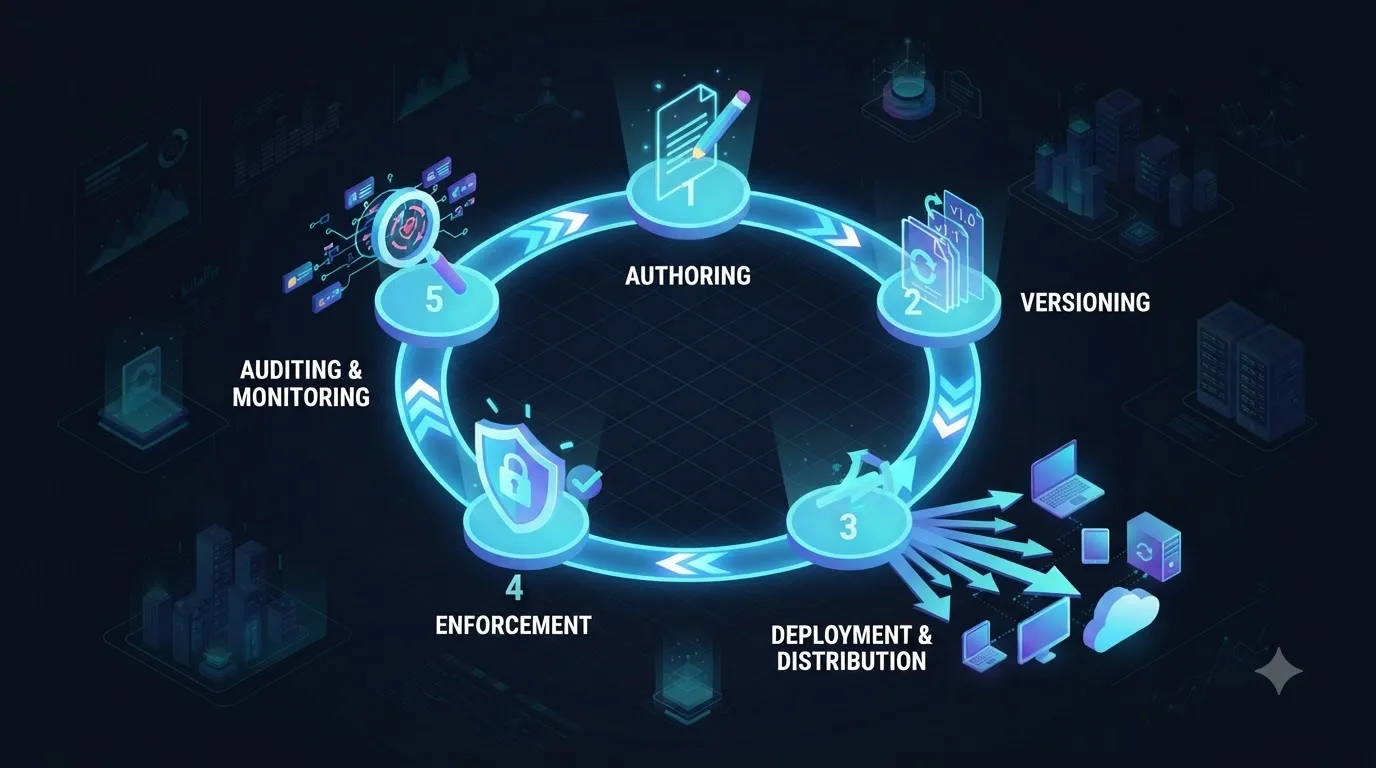
The three layers
Section titled “The three layers”1. Authored policy
Section titled “1. Authored policy”The authored layer stores reusable intent: policy metadata, typed file/signer/path rules, and policy options. It does not store a target-specific runtime identity.
Important properties:
- supplemental authored state does not persist a base-policy binding;
- rules are typed, not arbitrary XML blobs;
- the browser never generates policy artifacts;
- multiple variants can coexist under one policy.
2. Resolved deployment intent
Section titled “2. Resolved deployment intent”Before artifact generation, UEC resolves what a particular target should receive:
| Input | Result |
|---|---|
Device’s BaseDeviceGroupId |
The one base feed |
| Supplemental group memberships | Contributing additive trust |
| Effective mode metadata | Audit, enforce or disabled |
| Base context | Which base supplemental artifacts merge against |
This is why a supplemental policy can be reusable: its binding is computed for the target rather than frozen into the authored row.
3. Final artifact
Section titled “3. Final artifact”The final layer owns Windows-required identifiers and target output:
- base version emits Audit and Enforce artifacts with the same stable control identifier;
- supplemental policy emits a merged artifact per supplemental group and base context;
- identifiers such as
PolicyID,BasePolicyIDandVersionExare generated here; - agents receive artifacts through the artifact feed, not a legacy per-policy XML path.
Variant lifecycle
Section titled “Variant lifecycle”Draft → Review → Approved → Deprecated → Archived| Transition | Meaning | Guard |
|---|---|---|
| Draft → Review | Submit for inspection | Validation must pass |
| Review → Approved | Make eligible for assignment | Approval permission required |
| Approved → Deprecated | Flag replacement | Existing assignment continues |
| Deprecated → Archived | Remove from catalog | Version must be unassigned |
| Pre-approved → Archived | Discard unused work | Allowed when unassigned |
The canonical review action is Approve. UEC does not expose “Publish” or “Promote” as synonyms because those words hide which lifecycle transition occurred.
Assignment lifecycle
Section titled “Assignment lifecycle”- Approve a variant.
- Assign it to the correct group type:
- base policy → base device group;
- supplemental policy → supplemental group.
- Choose audit for a new or changed trust envelope.
- Wait for agents to download and report the artifact.
- Review execution telemetry.
- Promote to enforce for the smallest safe ring.
- Expand ring by ring.
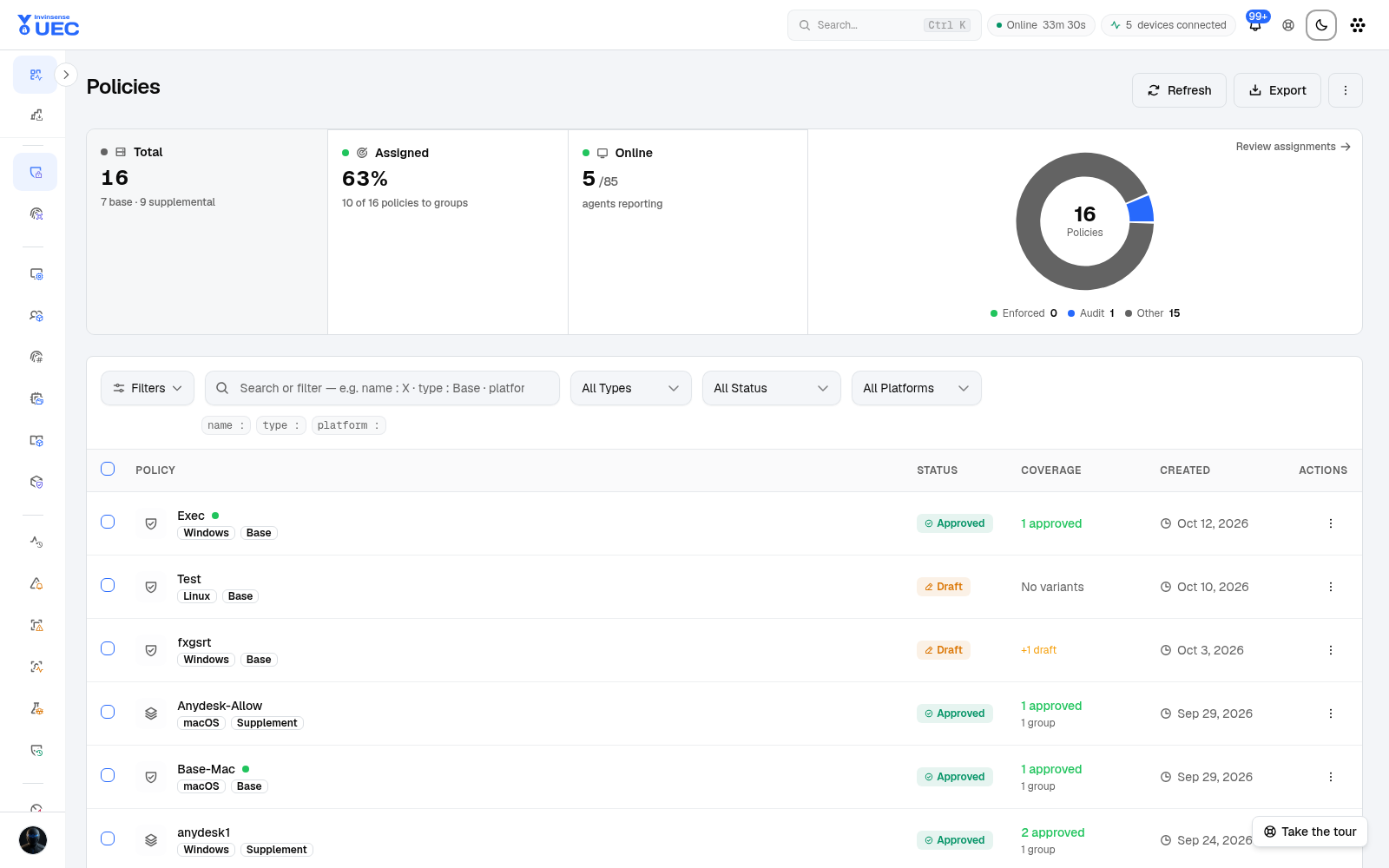
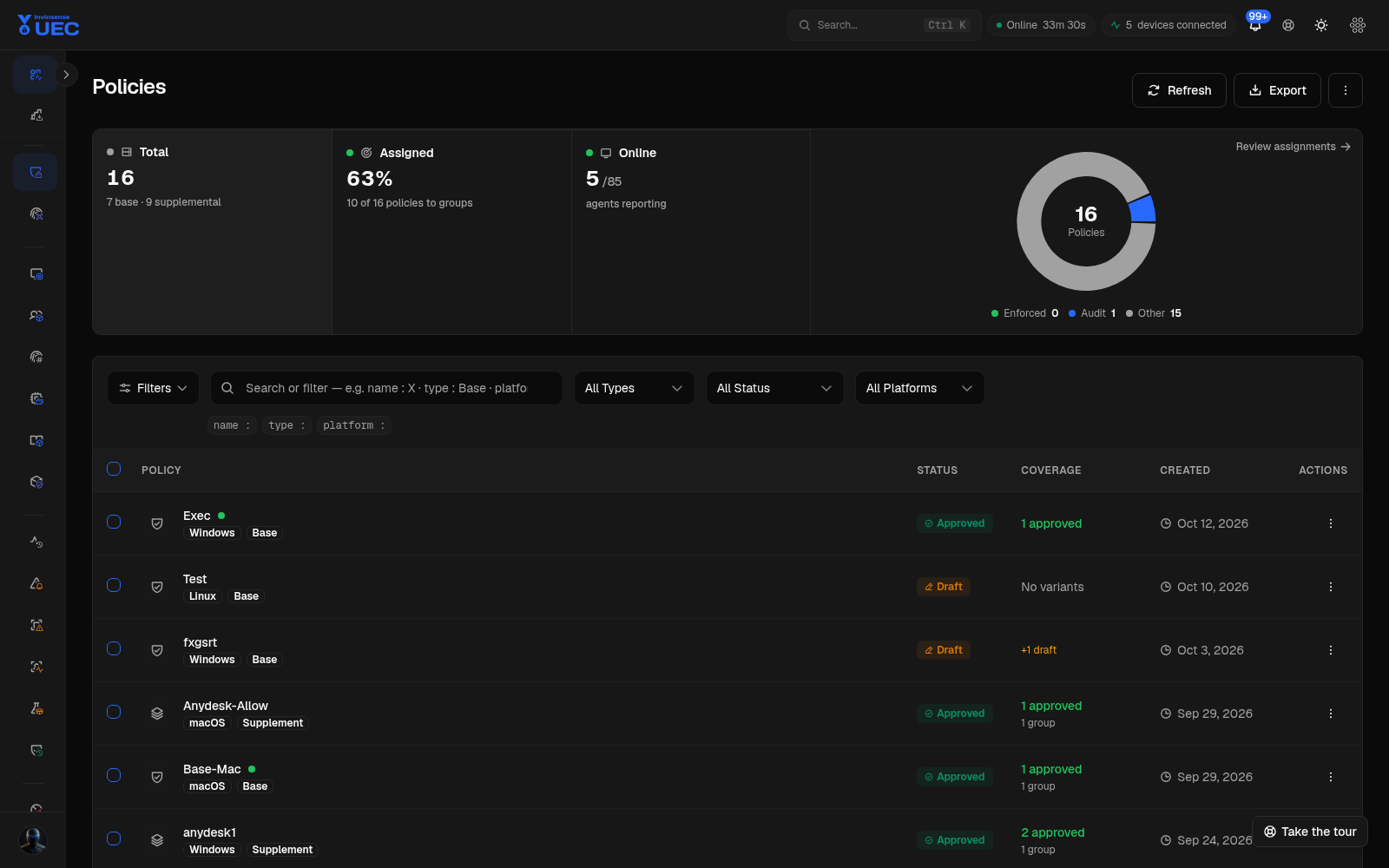
| Mode | Behaviour | Use |
|---|---|---|
| Audit | Policy evaluates and reports would-be decisions without blocking | New policy, changed trust, new ring |
| Enforce | Agent blocks behavior outside policy | After soak and operational sign-off |
| Disabled | Reset/remove policy from the device | Exceptional recovery, not routine administration |
Device-level mode divergence is an override, not a normal assignment. It requires expiry, has a tenant-configured maximum duration and leaves durable audit history.
Rules and trust anchors
Section titled “Rules and trust anchors”UEC prioritizes high-finity anchors over brittle ones:
- Publisher / signer TBS hash — allow a publisher’s cryptographic identity where possible.
- File path / PFN — useful when path stability is part of the control.
- Authenticode hash — precise but must be updated whenever the binary changes.
Do not use application names or version strings as trust anchors. They are useful for humans and classification, not cryptographic proof.
Policy options owned by the base
Section titled “Policy options owned by the base”A base policy owns platform behavior:
- HVCI / kernel integrity;
- Windows Update protection;
- managed installer;
- Intelligent Security Graph;
- script enforcement;
- whether supplemental policies may augment the base.
A supplemental policy cannot override these switches. This prevents two supplemental groups from inconsistently changing platform-wide guarantees.
Safe ring pattern
Section titled “Safe ring pattern”| Ring | Devices | Mode | Exit criteria |
|---|---|---|---|
| Ring 0 | 1–5 IT-owned devices | Audit | No boot, driver, security-agent or core business failures |
| Ring 1 | One department or pilot group | Audit | Business applications verified; false blocks converted to rules |
| Ring 2 | Pilot group | Enforce | 24–72 hours stable; response owner on call |
| Ring 3 | Business unit | Audit → Enforce | Change window and rollback owner |
| Broad fleet | Remaining groups | Enforce | Support process ready |
Keep a rollback owner and a rollback artifact before enforcement. A base policy failure can prevent software from running; that is more serious than a dashboard showing red.
Convergence and drift
Section titled “Convergence and drift”Policy convergence has multiple stages:
- Assignment saved.
- Artifact generated.
- Agent notified or sync hint received.
- Agent downloaded the correct artifact.
- Agent applied it.
- Heartbeat reported applied policy identity/mode.
- Events show the expected audit/enforce behavior.
Do not stop checking after step 3. Use Devices, Policy Deployments, Events and the device detail page to confirm the end-to-end state.
Audit and immutability
Section titled “Audit and immutability”Approval, assignment, mode changes, overrides, deprecation and archival are audit-worthy events. Approved rules are immutable; change happens through a new variant. This gives a stable review record and a precise rollback target.
See Audit Log for actor, resource and field-level diff review.